Pema Lingpa Lineage
Lineage Masters
The Three Great Treasure Revealers
Precious Treasure Teachings
Lineage Sadhanas and Ritual Texts
Sacred Objects of the Lineage
Blessed Amrita Pills
Guru Padmasambhava
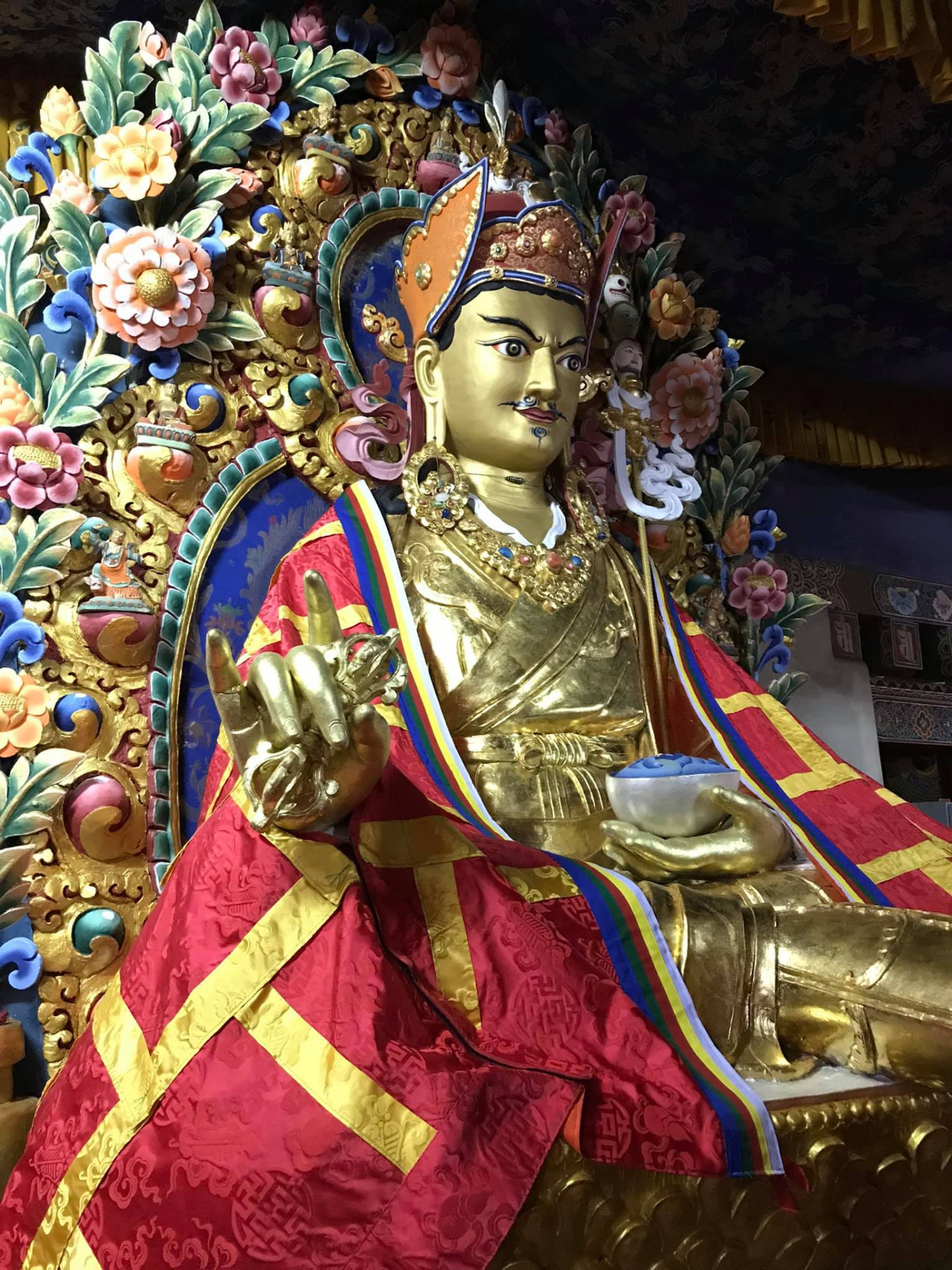
From the heart of Amitabha, a ray of radiant light emanated and shone upon an unopened lotus blossom in Lake Dhanakośa.
(The Ocean of Generosity Treasury, located in Uddiyana — present-day borderlands between Afghanistan and Pakistan.)
As the lotus flower blossomed open,
a miraculous child appeared within its petals,
adorned with all the auspicious marks and signs,
seated majestically upon a thousand-petaled lotus.
“Supreme Guru Padmasambhava,
please protect and guide me until enlightenment.”
Preface
The Buddha, Dharma, and Sangha — the Three Jewels — are inseparable from the Primordial Buddha, Samantabhadra, as well as the Three Roots: the Guru, Yidam, and Dakini. Above all, it is essential for practitioners to understand that Guru Padmasambhava and Amitabha are, in essence, inseparable and of the same enlightened nature.
For the purpose of spreading the Buddhadharma — especially the profound secret teachings of Dzogchen — Guru Padmasambhava manifests in countless forms throughout innumerable world systems, appearing according to the karma and needs of sentient beings in order to benefit them.
Because of this, there exist immeasurable and inconceivable accounts of Guru Rinpoche’s enlightened activity and miraculous life stories. In a sense, every sentient being possesses their own unique story and karmic connection with him.
What follows here is the most renowned and widely known account of Guru Padmasambhava’s life — the sacred biography familiar to generations of devoted disciples throughout history.
Birth
When the time came for Guru Padmasambhava to benefit and liberate the beings of this world, he miraculously manifested on the tenth day of the Monkey Month in a Monkey Year upon a blooming lotus in the sacred lake known as the “Ocean of Milk” in the southwest region of Uddiyana.
This lake, also called Lake Dhanakośa — the Ocean of Treasure and Generosity — is traditionally believed to have been located near the borderlands of present-day Afghanistan and Pakistan.
There are several different historical accounts concerning Guru Rinpoche’s birth. Some Indian historians describe him as having been born into the royal family or household of a minister in Uddiyana, while others state that he manifested upon Mount Malaya in Sri Lanka.
However, within Guru Rinpoche’s own revealed treasure teachings (terma), it is clearly affirmed that he manifested miraculously from within a lotus blossom. This is also the most widely known and universally accepted account among practitioners of the Vajrayana tradition.
Uddiyana
The sacred Ganges River of India is said to originate from the great holy mountain Kailash — Mount Meru — where four mighty rivers flow outward toward the four directions of the world. One of these rivers flowed westward into the kingdom of Uddiyana before eventually entering the Arabian Sea.
As the waters reached the land of Uddiyana, they gathered together to form a vast lake filled with blooming lotuses. From the roots of these lotuses flowed a fragrant milky-white nectar-like essence, and thus the lake became known as the “Ocean of Milk.”
Before the manifestation of Guru Padmasambhava, there appeared at the very center of the lake an enormous and magnificent fully blossomed red lotus.
Within the vast expanse of space, from the heart of Amitabha, the red seed syllable HRIH descended and landed upon the crown of the lotus flower. The syllable dissolved into radiant light, and from within that light appeared a miraculous eight-year-old child adorned with all the major and minor marks of enlightenment.
Seated majestically upon the lotus, holding a vajra and lotus flower in his hands, the child immediately began teaching the Dharma to the local devas, dakinis, and celestial beings.
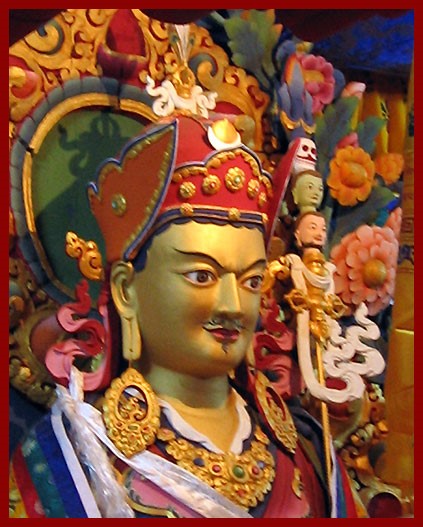
King Indrabodhi
At that time, the ruler of Uddiyana was the second King Indrabodhi, who lived in his royal palace together with his queen, surrounded by countless ministers, attendants, and members of the royal court.
Because the king had no son, on a full moon day during the summer month of May, he devoted himself wholeheartedly to making prayers and offerings to the Three Jewels. He then opened the royal treasury and generously distributed all of its wealth and treasures to the poor and needy, leaving nothing behind.
After all had been given away, the king cried out in sorrow:
“There are still suffering and impoverished people remaining, yet I have nothing left to offer them!”
Those who had not yet received anything replied to the king:
“If not everyone receives your generosity, then your previous acts of giving cannot truly be complete.”
Hearing these words, King Indrabodhi suddenly conceived of a way to obtain inexhaustible wealth for the benefit of all beings. He journeyed across the Ocean of Milk and requested from the Nāga princess the wish-fulfilling jewel that adorned her crown. Having successfully obtained the precious jewel, he returned safely with a great ship filled with the seven royal treasures.
During the voyage home, the king’s spiritual minister and religious advisor, Trig Na Dzin, discovered the miraculous child seated upon the lotus and reported the entire event to the king.
Overjoyed upon hearing the news, King Indrabodhi immediately went to meet the extraordinary child and respectfully asked:
“Who are your parents?
What is your family lineage?
From which land do you come?”
The child then replied in a majestic voice:
“My father is the self-arisen Samantabhadra.
My mother is Samantabhadrī, the expanse of ultimate reality.
My lineage is the union of primordial wisdom and the Dharmadhātu, the source of all phenomena.
And my name is the glorious Padmasambhava.”
The Lotus-Born One
After hearing the miraculous child’s reply, King Indrabodhi was filled wit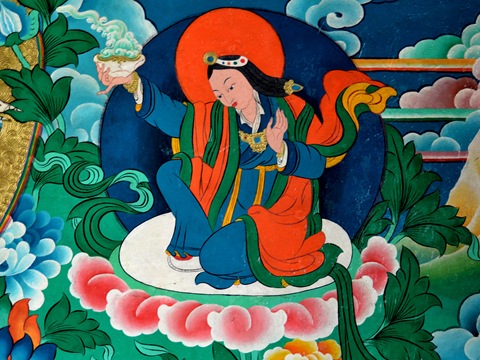 h wonder and joy. Realizing that the child was no ordinary being but a manifested Buddha, the king respectfully invited him to the royal palace, where he was treated both as a royal son and as the kingdom’s supreme spiritual guide.
The child became known as Padmasambhava — “The Lotus-Born One.”
As he matured, Guru Rinpoche married Princess Prabhadharani and governed the kingdom according to the principles of Dharma. He became the wise and virtuous king known as King Shikhabandha, the “King with Braided Hair.”
The Wrathful Vajra Manifestation — Rodravajrakāla
Eventually, Guru Rinpoche came to realize that worldly rulership and political life stood in opposition to the path of ultimate liberation, and that his royal position could never truly fulfill the deepest needs of sentient beings.
In order to renounce worldly life, he performed a mysterious and seemingly shocking act: he slew the son of an evil minister and liberated the consciousness of the deceased into the expanse of ultimate reality.
As a consequence, he was exiled to the terrifying charnel ground of Sitavana — a cemetery forest where corpses were left exposed for birds and wild animals to consume. It is also said that Gautama Buddha himself had once meditated there.
Gradually, through secret tantric practice in the great charnel grounds such as Nandanvana, Dhanabhumi, Parushakavana, and the other sacred cemeteries of India, Guru Rinpoche attained extraordinary siddhis — spiritual accomplishments and miraculous powers. Thereafter, he became known as Rodravajrakāla, the Wrathful Vajra Manifestation.
In order to inspire future disciples with confidence in the Buddhadharma, Guru Rinpoche traveled to Bodh Gaya and many other sacred places, outwardly displaying the appearance of receiving teachings from great scholars, mahāsiddhas, and yogis.
Yet after hearing the teachings only once, he completely mastered the entirety of the Buddhist canon — the Three Piṭakas:
-
Vinaya (the discipline teachings),
-
Sutra (the teachings spoken by the Buddha),
-
and Abhidharma (the philosophical and analytical teachings).
He fully understood all scriptures, doctrines, and meanings without difficulty.
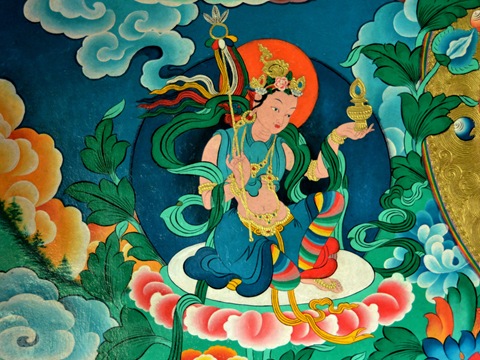
Marriage to Princess Mandāravā
Later, Padmasambhava took Princess Mandāravā, the daughter of King Shastradhara of Zahor (present-day Bengal, India), as his spiritual consort.
In order to preserve and establish the lineage of the dakinis, Guru Rinpoche and Princess Mandāravā journeyed together to the sacred Maratika Cave in central Nepal, where they practiced profound longevity sādhana for three months.
Through this practice, they attained the realization of the deathless vajra body, thereby accomplishing the state of a Vidyādhara of Long Life — an immortal awareness holder beyond ordinary birth and death.
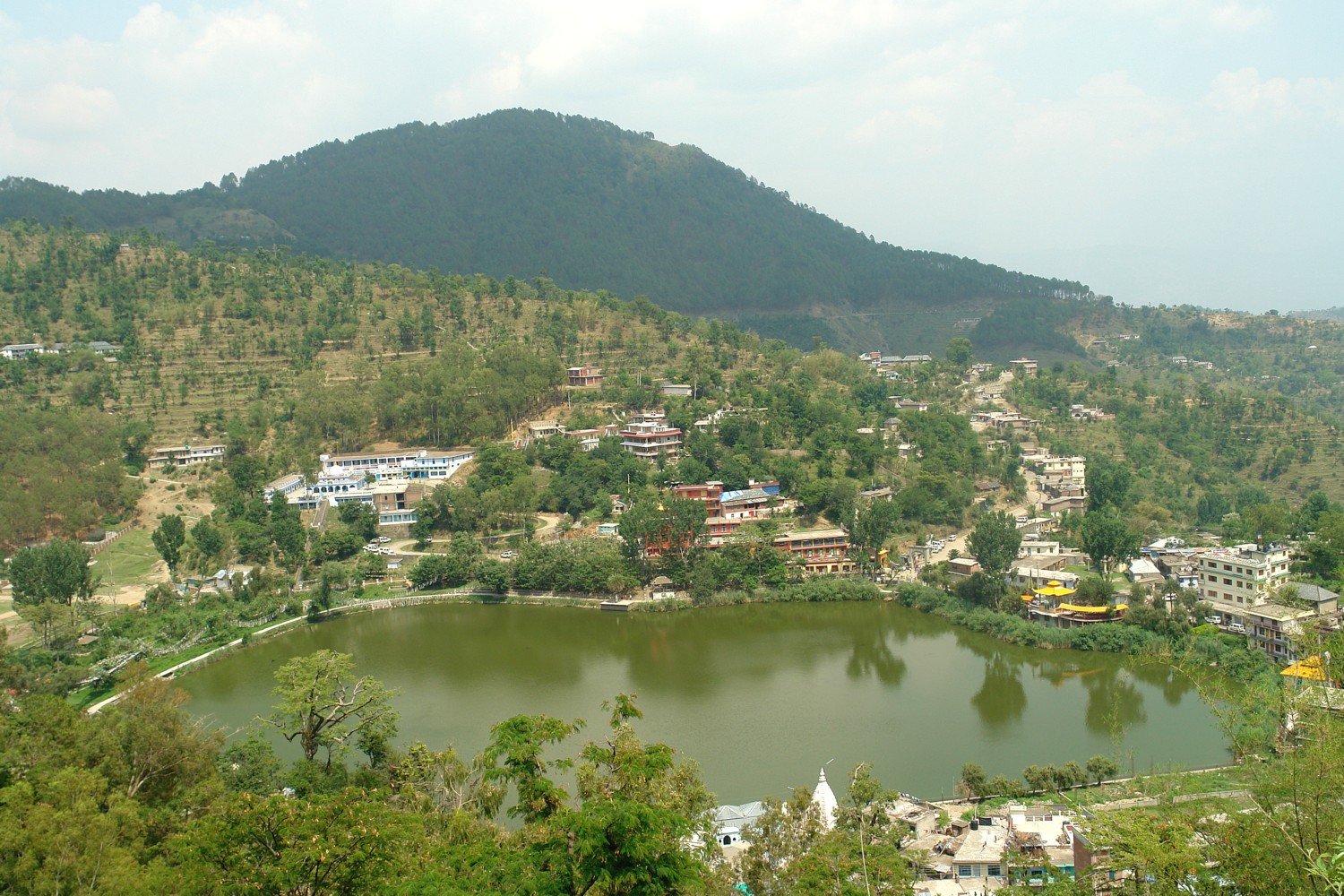
Tso Pema — The Lotus Lake of Guru Rinpoche
In order to benefit and tame the people of Uddiyana, Padmasambhava later returned to the kingdom disguised as a beggar. However, many people still recognized him.
Because of jealousy and fear, a group of evil ministers and hostile people bound Guru Rinpoche to a great pile of sandalwood and prepared to burn him alive.
Yet when the fire was ignited, the flames miraculously transformed into a vast lake filled with blooming lotuses.
At the center of the lake, Guru Rinpoche and Princess Mandāravā appeared seated majestically upon a great lotus flower. Witnessing this extraordinary miracle, the king, ministers, and all the gathered people were struck with awe. Their doubts vanished, and they developed profound faith and devotion toward Guru Rinpoche.
(Shown in the image on the right: Tso Pema — the sacred Lotus Lake of Guru Rinpoche in Rewalsar, India.)
In addition, Guru Rinpoche later attained the realization of the Mahāmudrā Vidyādhara at Yangleshö in Nepal.
These are some of the sacred events that occurred before Guru Rinpoche journeyed to Tibet.
The Master Spreads the Dharma in the Land of Snows
When Gautama Buddha entrusted Avalokiteshvara with the sacred task of bringing the Dharma to Tibet — the ancient Land of Snows — Avalokiteshvara gazed upon that wild and untamed land and wept tears of boundless compassion for the beings dwelling there.
From these compassionate tears manifested the celestial goddesses Ganga and Gangchungma.
One day, Gangchungma took flowers belonging to the heavenly realms. Because of this action, her celestial merit was diminished. As a result, when her life in the heavenly realm came to an end, she could no longer be reborn among the gods and instead took rebirth within the human realm as a woman.
The Sons of Dechogma
Because she had arisen from the compassionate tears of Avalokiteshvara, she naturally possessed immense faith and devotion toward the Buddhadharma. Thus, she began constructing a magnificent stupa for the Buddha’s sacred relics near present-day Kathmandu, Nepal.
However, before the stupa could be completed, she passed away.
Her four sons then vowed to fulfill their mother’s final wish by completing the construction of the stupa. With deep faith and sincere aspiration, they prayed wholeheartedly before the sacred structure.
When the stupa was finally completed, the four brothers each made great aspirations for their future lives:
-
one prayed to be reborn as a king who would uphold and protect the Buddhadharma,
-
another aspired to become a learned khenpo and great scholar,
-
another vowed to become a Vajrayana master,
-
and the last prayed to become the messenger who would unite the previous three together for the flourishing of the Dharma.
The biographies also recount that during the construction of the stupa, there was a clever donkey that helped carry materials and labor tirelessly for the project.
One day, the donkey accidentally overheard the aspirations made by the four brothers. At that moment, it thought to itself:
“I worked so hard helping them build this stupa, yet when they dedicated their aspirations and merits, they never once thought of me!”
Filled with resentment, the donkey made a vow:
“As much as I am able, I will obstruct and disrupt the fulfillment of their great aspirations.”
King Trisong Deutsen
Through the power of their aspirations, one of the four brothers was reborn as King Trisong Detsen, the thirty-eighth king of Tibet and an emanation of Mañjuśrī, the Bodhisattva of Wisdom.
Another brother was reborn as the king’s messenger, whose task was to invite the great Indian abbot Shantarakshita and the Vajrayana master Padmasambhava to Tibet. These two masters were themselves the rebirths of the remaining two brothers.
Remembering his former aspirations and sacred vows, Guru Rinpoche accepted the invitation and journeyed toward Tibet. Along the way, he subdued countless obstructing spirits, demons, and harmful forces, binding them by oath to become protectors of the Buddhadharma.
After arriving in Tibet, the King, Guru, and Abbot together established Samye Monastery — the first monastery in Tibet to house Buddhist statues, ordained sangha, and a complete monastic system.
There, the first seven Tibetan monks received novice ordination, becoming the foundation of the Tibetan monastic tradition.
Guru Rinpoche and the great masters also standardized the methods for translating Sanskrit into Tibetan and supervised the translation of vast numbers of Buddhist scriptures and tantric teachings.
Most importantly, they firmly established for the first time in Tibet the complete tradition of study, contemplation, and meditation practice within the Buddhadharma.
These three stages are regarded as the essential path of Buddhist training:
-
Study (Hearing) — diligently learning and receiving the teachings,
-
Contemplation — carefully reflecting upon and discerning the meaning of the Dharma,
-
Meditation (Practice) — cultivating stable realization through meditative practice, ultimately giving rise to pure wisdom free from all afflictions.
Langdharma — The Demon King
As for the donkey that once helped construct the sacred stupa, it was later reborn as Langdharma, the forty-first king of Tibet.
Driven by the force of its former negative aspiration, Langdharma eventually launched a severe persecution against Buddhism and nearly succeeded in eradicating the Buddhadharma from Tibet altogether.
Treasures Concealed
Padmasambhava tirelessly traveled throughout the entirety of Tibet, blessing countless mountains, lakes, caves, and sacred places as future sites of realization and spiritual accomplishment.
In the upper region of Tibet, Ngari, he blessed twenty sacred caves. In Central Tibet, he consecrated twenty-one sacred practice sites destined to become places of accomplishment. In the eastern region of Kham, he blessed twenty-five sacred locations, along with many other regions throughout Tibet — including the king’s three principal territories across Upper, Central, and Lower Tibet, the five provinces, three great valleys, islands, and numerous hidden lands.
For the benefit of future generations, Guru Rinpoche concealed eighteen categories of sacred treasures (terma), including:
-
Dharma scriptures,
-
ritual texts,
-
sacred statues,
-
gold and precious substances,
-
and many other spiritual treasures.
At the same time, he left extraordinarily detailed prophecies and instructions regarding these hidden treasures — including the identity of the future treasure revealers (tertöns), the protectors assigned to guard the treasures, the precise times when they would be revealed, and the conditions under which they would benefit sentient beings in future ages.
The Eight Manifestations of Guru Rinpoche
In order to benefit and guide different kinds of sentient beings, Padmasambhava displayed eight principal manifestations, each revealing a unique enlightened activity:
-
Padmavajra (Lotus Vajra / Ocean-Born Vajra)
- The manifestation that cuts through the root of the five poisons.
- Padmarāja (Lotus King)
The manifestation that grants beings supreme benefit and prosperity within worldly life. - Padmasambhava (The Lotus-Born Guru)
The manifestation that blesses beings and awakens deep faith and devotion. - Dorje Drolö (Wrathful Vajra Tamer)
The fierce manifestation that subdues arrogant beings, spirits, and harmful forces. - Sūryaprabha (Sun-Ray Guru)
The manifestation that reveals the essential nature of the secret Vajrayana teachings. - Śākyasiṃha (Lion of the Śākyas)
The manifestation that guides beings onto the path of liberation. - Siṃhanāda (Lion’s Roar)
The manifestation that overcomes and dispels the interference of false views and hostile forces. - Dhimanvaruchi (Wisdom-Loving Guru)
The manifestation that extensively bestows scriptures, mantras, and profound teachings.
Accomplishments
The accomplishments of Guru Rinpoche were inconceivable.
Among his disciples, the twenty-five great disciples and eighty accomplished students all attained liberation from samsara through realization of the rainbow body.
In addition:
- three million disciples became firmly established in various levels of Vajrayana practice,
- one hundred thousand displayed signs of realization,
- ninety thousand attained the flawless luminous illusory body,
- and eighty million disciples achieved various degrees of spiritual accomplishment.
Length of Life
According to traditional accounts, Guru Rinpoche remained in India for approximately 3,600 years, continuously supporting the Buddhadharma and benefiting sentient beings.
Regarding the length of his stay in Tibet, various historical accounts differ — some claiming he remained for three years, others six years, thirteen years, and so forth.
However, according to Guru Rinpoche’s own revealed teachings, he actually remained in Tibet for fifty years and three months.
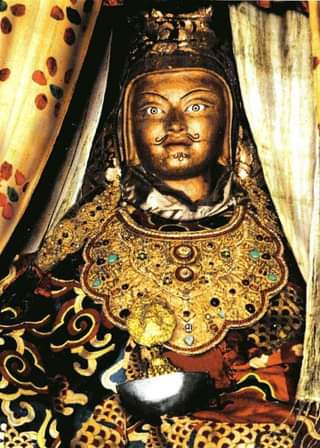
With compassion as vast and boundless as the infinite sky, Padmasambhava tirelessly benefited beings throughout the six realms of existence.
May we always remember his immeasurable enlightened deeds, his countless precious teachings, and the inexhaustible treasure revelations he bestowed for the benefit of future generations.
Above all, Guru Rinpoche displayed extraordinary compassion toward the beings of Tibet, the Land of Snows, bringing the light of the Buddhadharma to flourish there for countless ages.
Source: Official Website of Namdroling Monastery of the Nyingma Palyul TraditionPalyul Official Website Translator: Pema Chökyi