Pema Lingpa Lineage
Wisdom Dakini Yeshe Tsogyal
A Brief Biography of Lady Yeshe Tsogyal
Author: Li Shouli
Lady Yeshe Tsogyal was born to her father Karchen Palgyi Wangchuk and her mother Gewa Tso. Although the ancestors of her father’s family had followed the Bön tradition, from his own generation onward he developed faith in the Buddhadharma. In accordance with the command of the Tibetan king, he led all the people under his authority to enter the Buddhist path.
One night when her parents were twenty-five years old, both of them beheld different visions of an eight-and-a-half-year-old Sarasvatī. They also heard the sounds of the sixteen Sanskrit vowels, such as “A” and “Ā,” together with the mantra “sha sha sha sha sha.”
The next morning, a celestial maiden, never seen before, appeared at their doorway in the form of a beautiful woman and said:
“The Three Jewels — the Buddha, Dharma, and Sangha — have arrived. How wonderful!”
Having spoken these words, she immediately vanished without a trace.
Nine months later, at sunrise on the tenth day of the Monkey Month in the Year of the Bird, Yeshe Tsogyal was born. At that time, the sound of a lute resounded throughout the sky, a rain of flowers descended, and five-colored rainbows appeared above the palace. Immediately after birth, she was able to recite the vowels, consonants, and the heart mantra of Guru Padmasambhava.
Her father said:
“The lake opposite us has also risen and expanded. Let this child be named Tsogyal.”
In Tibetan, “Tsogyal” carries the meaning of “Queen of the Lake” or “Sovereign of the Ocean.”
Because her appearance was extraordinarily beautiful and majestic, her family kept her from going outside for ten years out of concern for her safety. By the time she reached the age of ten, the fame of her beauty and noble bearing had spread throughout many regions of Asia. High officials from Nepal, China, and many other places came to seek her hand in marriage, but she refused them all. Eventually, King Trisong Deutsen took her as his queen.
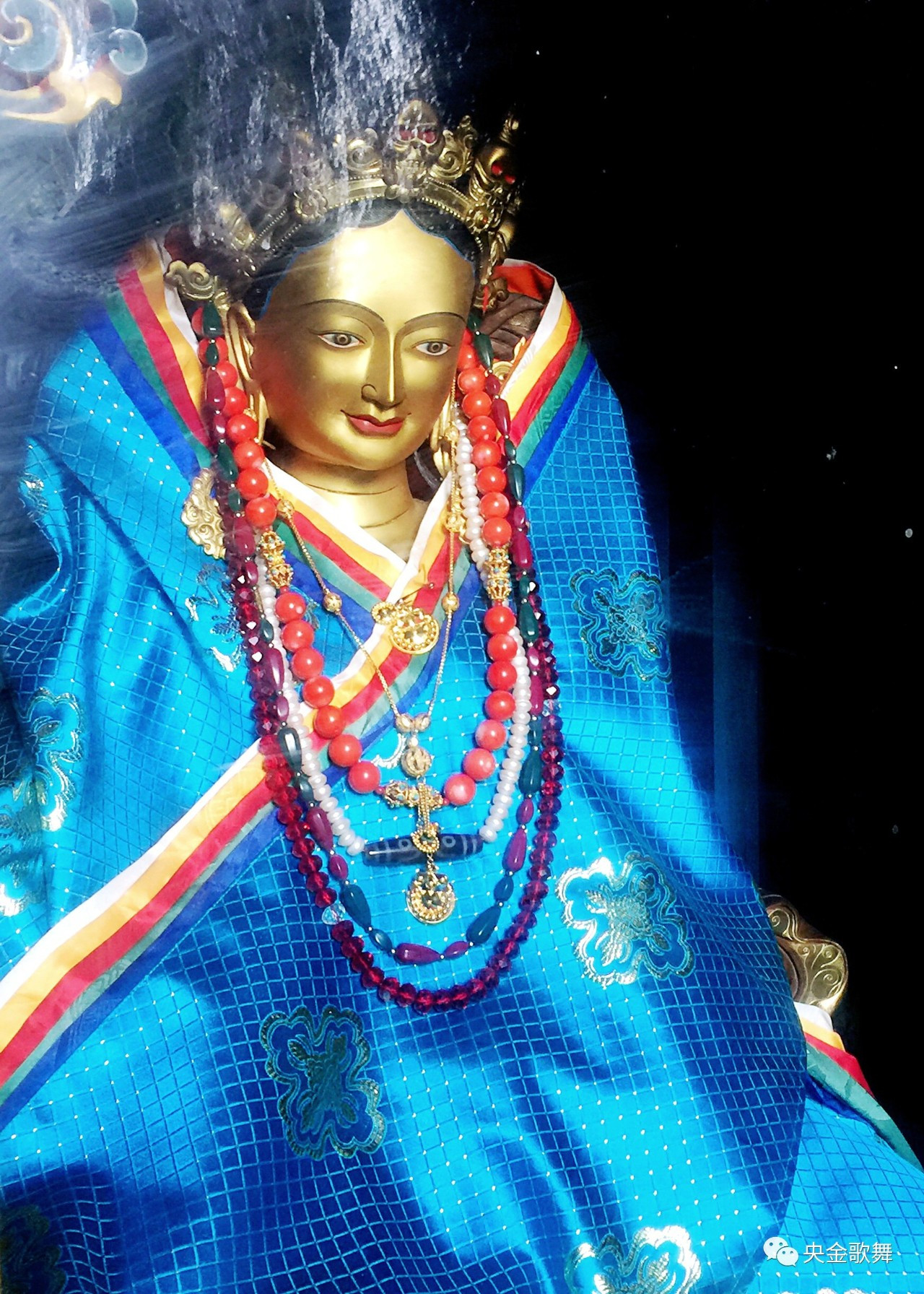
She had deep faith in and interest toward the Buddhadharma. While living in the palace, she was entrusted with Dharma-related affairs and studied writing, the five sciences, and other fields of knowledge. Whatever her teachers taught her only once, she understood completely.
At that time, Guru Padmasambhava was invited to preside over a great ganachakra feast offering. In the shrine hall, numerous offerings were arranged, including golden offerings heaped upon a silver mandala plate. It was an exceedingly grand Dharma assembly, during which the majestic Guru Padmasambhava bestowed teachings and transmissions.
Lady Yeshe Tsogyal then gave rise to renunciation toward samsara, together with a deeper aspiration and faith to study the Dharma. She requested permission from the king to leave the palace and follow Guru Padmasambhava. The king agreed and offered Yeshe Tsogyal to the Guru. Guru Rinpoche joyfully accepted her, and the two returned to Chimphu Gewu.
After a long time, on the occasion of the Tibetan New Year, the ministers and subjects gathered in the royal palace. The ministers began questioning the whereabouts of Yeshe Tsogyal, asking what had happened to her. Since no one could give a clear answer, they directly questioned the king.
The king openly told them the truth: that he had offered her to Guru Padmasambhava.
Hearing this, the ministers spoke in one voice:
“Great King, revered lord of the Tibetan people! Has some demon possessed your body? Do not treat your ministers like dogs. The moral customs handed down by our ancestors have been disturbed by this wandering foreigner, Padmasambhava, this unruly Acharya from the borderlands. He enjoys everything without labor — this is a tragedy for the Tibetan people!”
The ministers then held an urgent council. The king, having no other choice, outwardly agreed to impose punishment. As a display to satisfy the ministers, he pretended to exile Guru Padmasambhava to India and Lady Yeshe Tsogyal to the region of Lhodrak. In reality, however, both the Guru and the Lady were secretly escorted to the sacred place of Shotö Drak, the great palace of the dakinis, where Guru Rinpoche continued to transmit the Dharma to her without any disturbance from the outside world.
Lady Yeshe Tsogyal arranged a common mandala offering and first made nine full prostrations before the Guru, requesting the Dharma. Guru Rinpoche then opened the mandala of the Khandro Nyingtik. Within the mandala of the Guru’s enlightened body, the five Vajradhara father-and-mother deities appeared, and he bestowed the empowerment of the Guru’s enlightened body. Through this, the five aggregates were purified and transformed into the five kayas. The outer vase empowerment revealed the external world as a celestial palace, while all inner sentient beings were seen as sacred deities. She practiced this for seven days.
Guru Rinpoche also bestowed the empowerment of the unsurpassed secret mantra. He manifested as the yidam Hayagriva, while she transformed into Vajravarahi. Through this, she realized the channels, winds, and essences. The five poisons were purified and transformed into the five wisdoms, and she attained the undefiled samadhi of bliss and emptiness. She likewise practiced this for seven days.
Guru Rinpoche then appeared in union as the red Heruka with the sixty-one Heruka deities and their retinue. He directly pointed out to her the innate wisdom of great bliss. All subtle obscurations, afflictions, and habitual tendencies were purified, and she became capable of benefiting sentient beings throughout the ten directions. At that time, Guru Rinpoche bestowed upon her the secret name “Yeshe Tsogyal.”
Guru Rinpoche then prophesied:
“From this day onward, the time has come for you to enter the path of the Great Perfection, Ati Yoga. However, in order to practice the profound secret teachings of Dzogchen, you must have a spiritual consort. In Nepal there is a seventeen-year-old wandering acharya named Sale, who came from India. He is an emanation of Hayagriva and bears a red mole upon his chest. You must go and find him; only then will you swiftly attain the pure realm.”
Lady Yeshe Tsogyal then set out for Nepal. On the way, she encountered seven bandits. After she sang them a Dharma song, their minds were transformed. With deep faith, they confessed their wrongdoings, gave rise to renunciation toward samsara, and requested teachings and pith instructions from her. In the end, they all attained liberation.
When she arrived before the Boudha Stupa in Kathmandu, she made prayers. Light radiated from the stupa, and Guru Padmasambhava himself appeared before her, giving her a prophecy.
Nearby, in a small town, she found the young man Sale. However, he was living as a servant, and his master was unwilling to let him go. Standing at the master’s doorway, Lady Yeshe Tsogyal explained everything in detail.
The master replied:
“Although he is my servant, he is like my own child. It was not easy to obtain him. Do you have five hundred measures of gold? If not, and if you truly love him, then you may remain here and serve as my servant together with him.”
At that time, she had only one hundred measures of gold and was left helpless.
Just then, the only son of a local landowner had died, and the grieving parents had placed his body inside their home. Lady Yeshe Tsogyal went to console the two elderly parents and said:
“If you are willing to give me five hundred measures of gold, I can bring your son back to life.”
The landowner was overjoyed and replied:
“If my son can be revived, not to mention five hundred measures of gold — even fifty million measures would be possible.”
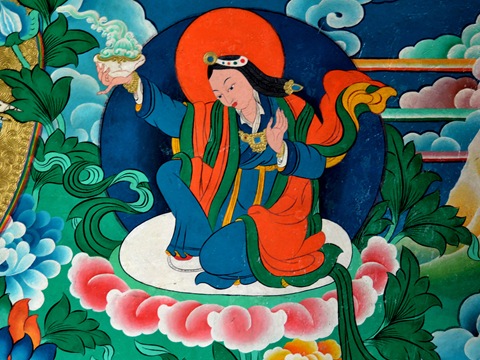
Lady Yeshe Tsogyal covered the body with a white cloth and blessed the five aggregates one by one. At last, the deceased was restored to life. From that time onward, her fame spread throughout the ten directions.
While in Nepal, she also encountered several great accomplished disciples of Guru Padmasambhava. After exchanging Dharma views and realizations with them, she brought Sale back to Tibet.
Guru Rinpoche greatly praised them and opened the mandala, bestowing the Guru empowerment upon both of them. Through this, Sale was also led onto the path of awakening and liberation. He realized both the definitive and provisional meanings of the Dharma, and together with Yeshe Tsogyal, he continued in practice until both attained accomplishment.
They practiced in a cave for seven months, realizing the four joys: joy, supreme joy, special joy, and innate joy. Through this practice, their bodies became free from birth, aging, sickness, and pain. Like vajra itself, they gained mastery over the four elements and accomplished the four joys.
At Samye Chimphu Cave, Guru Padmasambhava transmitted the Guhyagarbha practice liturgies and one hundred oral instructions, including practices centered on Amitāyus, to his great disciples Ma Rinchen Chok and Yudra Nyingpo, instructing them to practice diligently at Samye Chimphu.
At that time, Guru Rinpoche also transmitted to Lady Yeshe Tsogyal the outer, inner, secret, and innermost essence teachings, as well as the method of practicing the Three Roots as a single unified mandala. He specifically instructed her to practice at sacred places such as Omphu Taktsang and Men Taktsang. “Taktsang” in Tibetan refers to a “Tiger’s Lair,” or a cave dwelling of a tiger.
In these sacred caves, one can behold naturally appearing images of Guru Rinpoche. In particular, Guru Rinpoche instructed her to practice deeply at the Driktrö Dakini Palace.
Guru Rinpoche told her:
“You will encounter many hardships. Pray to me with unwavering devotion, and I will personally come to guide you. During your practice, you must never separate from your practice companion, Acharya Sale.”
Following Guru Rinpoche’s instructions, Lady Yeshe Tsogyal went to the Driktrö Dakini Palace and Tsogyal’s Secret Cave, where she engaged in long-term retreat practice. The local faithful devotees respectfully offered her the food and clothing necessary for practice.
Lady Yeshe Tsogyal practiced the peaceful deities of the Hundred Peaceful and Wrathful Deities as inseparable from Guru Padmasambhava. Many yidam deities appeared directly before her. She realized the channels and winds as the empty mandala and became able to benefit sentient beings without obstruction. She also realized the essence-drops as manifestations of the Guru and received countless blessings.
Later, Lady Yeshe Tsogyal went to the summit of Driktrö Mountain and practiced tummo with great hardship. Upon the snow and frost, she laid only a thin cloth and practiced in this way for an entire year.
At the beginning, when her tummo practice had not yet generated warmth, the conditions were extremely difficult — especially during the New Year, when the weather became bitterly cold. Unable to endure the hardship, Acharya Sale temporarily left. Yet Lady Yeshe Tsogyal had made a vow: until she attained accomplishment, she would not leave.
Because of the extreme cold, blisters arose all over her body, and her skin cracked with frost wounds. Whenever the suffering became almost unbearable, she prayed to Guru Padmasambhava with deep devotion. Gradually, signs of transformation appeared in her body, and the warmth of tummo began to arise.
She continued persevering in practice. At that time, Guru Rinpoche appeared before her and said:
“I shall transmit to you the most profound teachings. You must uphold them well. I shall entrust all the secret mantra teachings to you, open the mandala, and transmit to you many mandala teachings of the unsurpassed tantras.”
Guru Rinpoche then prophesied:
“The time has come for you to benefit sentient beings.”
Lady Yeshe Tsogyal then brought Acharya Sale and Dewamo to a place called Mengshing Kezhong, where they engaged in practice and attained accomplishment. Her body attained the indestructible vajra body; her speech attained the melodious voice of Brahma; and her mind attained undefiled vajra samadhi.
At that time, Lady Yeshe Tsogyal felt that the time had come to practice the Yangdak teachings. In order to purify the karmic obscurations of speech, she recited mantras continuously. First, she recited the Hundred-Syllable Mantra, and later she practiced confession through the outer tantras of Kriya, Charya, and Yoga within the nine-yana system.
Day and night, she recited the scriptures of the Sutras, Vinaya, and Abhidharma, engaging in intense practice without interruption. Eventually, she practiced to the point that her mouth became dry, her face swollen, and blood flowed from her mouth. Only then did her speech attain accomplishment.
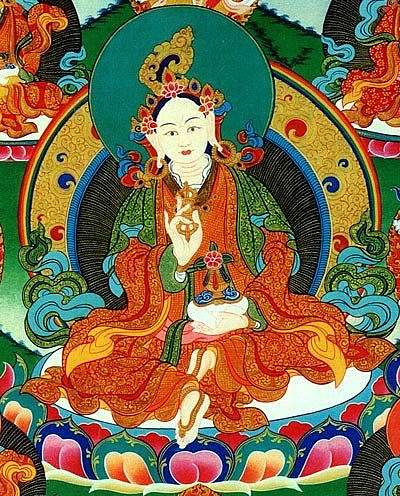
At this time, Lady Yeshe Tsogyal had attained unobstructed eloquence and the accomplishment of perfect memory, never forgetting anything she had heard or learned.
Afterward, she began practicing the Eight Great Heruka deities of the unsurpassed yoga tantras, continuing until she herself accomplished the state of the deity.
Sitting in full vajra posture with her hands in the mudra of meditation, she practiced with single-pointed concentration. One by one, the Eight Great Heruka deities appeared before her, radiating brilliant light, and signs of accomplishment began to arise. During this process, the deities also prophesied that she would attain the uncommon eight great accomplishments and ultimately reach vajra-like meditative stability, attaining liberation within the dharmadhātu of Samantabhadra.
When Lady Yeshe Tsogyal practiced at Mount Kala, many devoted followers gathered around her, and thus people came to call her “Lady Kala.” Among her disciples, thirty-nine attained accomplishment and displayed miraculous powers; twenty of them became capable of benefiting sentient beings, and seven attained realization inseparable from that of Lady Yeshe Tsogyal herself. Through this lineage of practice, countless beings were benefited.
When Lady Yeshe Tsogyal went to Gyomunang, more than one thousand female practitioners gathered around her. Among them, seven hundred became truly capable of benefiting beings, seven reached the same level of realization as Lady Yeshe Tsogyal, and five hundred attained accomplishment.
One day, while traveling toward Mount Shangpo, she encountered seven bandits. They stole all her belongings and intended to violate her. At that moment, Lady Yeshe Tsogyal sang the teachings of the Four Joys in a melodious voice and bestowed Dharma teachings upon them. Through her blessings and instructions, the bandits attained realization, and all seven became her disciples.
The group of eight then traveled to Kathmandu, Nepal. Her former patrons, as well as the king of Nepal at that time, requested teachings from her. Lady Yeshe Tsogyal transmitted many secret instructions of Guru Padmasambhava, explained the teachings of karma and causality, and gathered countless male and female disciples. Through her activities, even remote regions of Nepal were nourished by the Dharma.
She accepted many disciples there and especially transmitted the teachings of the unsurpassed tantras. Disciples such as Kala Siddhi, Lodrö Kyi, Dechenmo, and Sadra attained accomplishment through these teachings.
Later, King Mutri Tsenpo of Tibet sent three ministers to invite Lady Yeshe Tsogyal back to Tibet. She instructed her great disciple Lodrö Kyi to remain in Nepal and continue spreading the Dharma, while she returned to Tibet with thirteen disciples, including Kala Siddhi.
On the journey back, as they passed through places where she had previously practiced, such as Kala, many devotees made abundant offerings. When she arrived at Samye Monastery, the king received her with a grand ceremony and escorted her to the upper floor of the main temple.
At that time, many of her old acquaintances — now great translators, ministers, and ordinary citizens — were filled with joy and excitement upon seeing her again after so many years. Since Khenpo Bodhisattva had already passed into parinirvana, Lady Yeshe Tsogyal wept and offered a mandala before his reliquary stupa.
She then went to Samye Chimphu Cave, where Guru Padmasambhava was residing. With the king serving as patron, offerings were made to both Guru Rinpoche and Lady Yeshe Tsogyal. They remained in the cave for eleven years, widely transmitting the Dharma.
During those eleven years, Guru Padmasambhava transmitted vajra secret mantra teachings and profound pith instructions to Lady Yeshe Tsogyal. By that time, their realization had become completely inseparable.
Guru Rinpoche then told Lady Yeshe Tsogyal that before long he would depart from this world and travel to the Glorious Copper-Colored Mountain Pure Land. He said:
“I shall leave inexhaustible teachings for the people of Tibet. These hidden treasures shall be entrusted to you for safekeeping.”
With the support of the Tibetan king, Guru Rinpoche and Lady Yeshe Tsogyal remained at Samye Chimphu Cave for eleven years, giving many teachings to the king, queens, ministers, and ordinary people.
On the tenth day of the Monkey Month in the Year of the Monkey, Guru Padmasambhava departed from this world and journeyed to the Glorious Copper-Colored Mountain.
After Guru Rinpoche’s departure, Lady Yeshe Tsogyal continued to spread the Dharma and benefit beings. She concealed Guru Rinpoche’s treasure teachings throughout Tibet, scattering them across the land for the benefit of future generations.
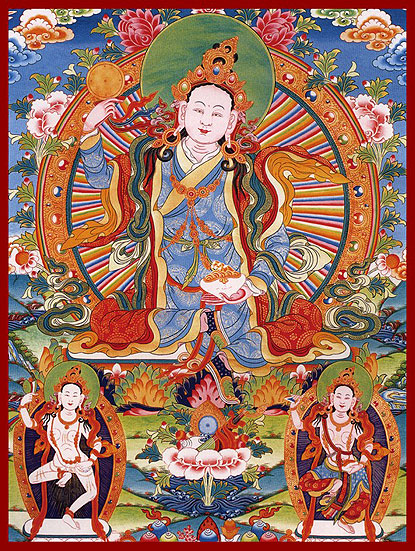 At the age of 211, at dawn on the tenth day of the lunar month, four radiant dakinis appeared, holding an eight-petaled lotus, and placed it before Lady Yeshe Tsogyal.
Immediately, Lady Yeshe Tsogyal rose. Holding a damaru in one hand and a curved ritual knife in the other, she walked gracefully into the lotus. Surrounded by many devoted disciples and followers, she dissolved into the radiant light of the lotus and disappeared.
The disciples wept helplessly and cried out:
“After you depart, what shall we do? How shall we explain this to the people of Tibet? Who will guide our practice from now on?”
At that moment, Lady Yeshe Tsogyal’s voice resounded from the sky, instructing the disciples on how they should continue their practice. Thereafter, she departed from this world.
Among the disciples taught by Lady Yeshe Tsogyal were eleven principal disciples, including Ma Rinchen Chok and Ödzer Palgyi Zhönnu, together with many other accomplished practitioners. Countless devotees received her teachings and blessings.
She is revered as one of the greatest female realized masters in the history of Tibetan Buddhism.