Pema Lingpa Lineage
Pema Lingpa, the Treasure King of Bhutan and one of the Five Great Tertön Kings of Tibetan Buddhism.
 The History of Terma
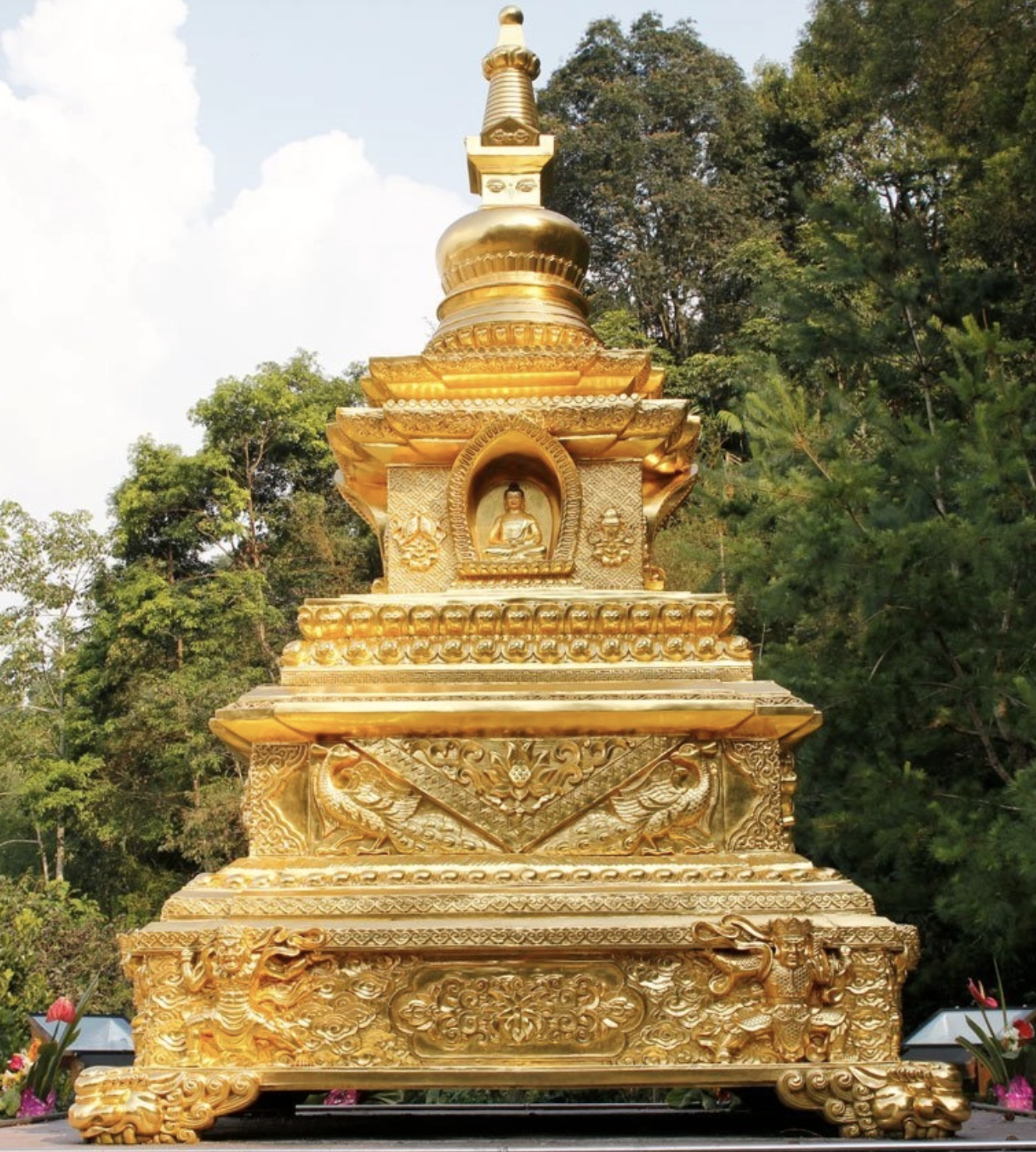
One of the most renowned and distinctive features of the Nyingma tradition is its sacred terma teachings — hidden treasures of Dharma. The origins of this tradition can be traced back to the Buddhist scriptures themselves. Although the term “terma” may not always be explicitly used, certain Mahayana sutras contain accounts that correspond to the opening of hidden treasures.
For example, in The Sutra of the Dhāraṇī of the Precious Casket Seal of the Secret Whole-Body Relics of All Tathāgatas, it is recorded that the Blessed One came upon an ancient ruined stupa in a garden called “Abundant Wealth.” The stupa had collapsed and was covered with thorns, vines, broken tiles, and earth, appearing like a mere mound of soil. Yet when the Buddha approached, great light radiated from the stupa, and a voice arose from within the mound praising the Buddha and declaring that great benefit had been obtained. This passage may be understood as an account of the Buddha opening a hidden Dharma treasure.
Therefore, terma refers to pure Dharma teachings concealed for the benefit of beings in future times. Such teachings may be hidden in the earth, in space, in water, or even within the mind itself. When the proper time and conditions have ripened, they are revealed by a prophesied master known as a tertön, or treasure revealer, in order to benefit future generations of sentient beings. Since these teachings are directly connected to the enlightened intent of past masters, they are also known as a “near transmission.”
Before a terma is revealed, it is protected by terma guardians specifically entrusted by Guru Padmasambhava. Through their protection, the teachings are not destroyed by war, the decline of Dharma, or the elements of earth, water, fire, and wind. Even if the place where a treasure was originally concealed is damaged, the treasure may be moved elsewhere by its guardian dakinis and heroes, awaiting the destined master who will reveal it. When it is opened, through the power of Guru Rinpoche’s aspirations and prophecies, the terma teaching will spread widely, benefiting not only the tertön himself but countless sentient beings.
According to the prophecies of Guru Padmasambhava, for the benefit of beings in future times, there would appear Five Great Treasure Kings, one hundred and eight great tertöns, and more than one thousand minor tertöns.
Those who reveal individual practices, liturgies, or ritual texts are known as minor tertöns. Those who reveal accomplishment practices of Dzogchen, Avalokiteshvara’s great compassion, and the Three Roots are known as great tertöns.
A Treasure King, however, not only reveals the accomplishment practices of Dzogchen, Avalokiteshvara, and the Three Roots, but also becomes the principal source of guidance, inquiry, study, and reliance for all other tertöns of that era. Thus, the Treasure King is likened to the sun, the great tertöns to the moon, and the minor tertöns to the stars.
For this reason, the treasures revealed by a Treasure King are not only rare, wondrous, and profound, but also complete root tantras and essential systems of practice. When the teachings revealed by other tertöns are incomplete, they must be supplemented and clarified according to the terma teachings of the Treasure King, thereby becoming complete and whole.
Furthermore, the treasures of a Treasure King serve as the standard by which other revealed treasures may be examined — determining whether they are pure and authentic, or whether they are false treasures. This is why the lineage of a Treasure King is considered exceptionally important among all Dharma lineages and must never be allowed to decline.
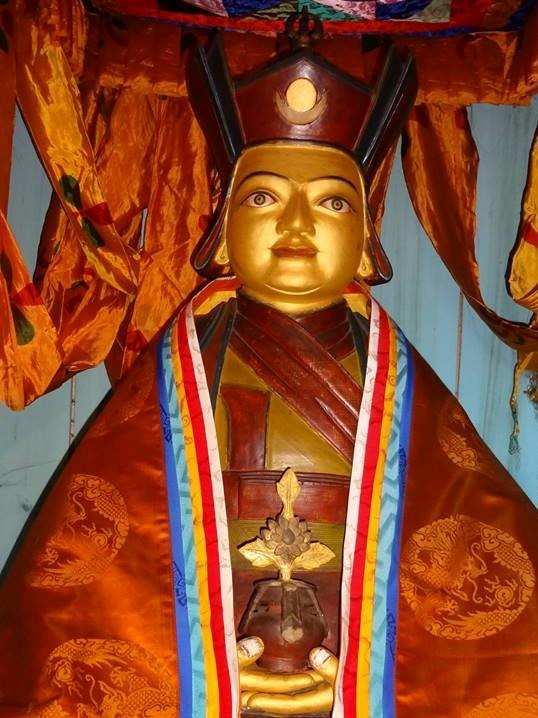 The Previous Lives of the Treasure King Pema Lingpa (Padma Lingpa)
The story of Pema Lingpa, the Treasure King Padma Lingpa, differs from that of many other realized masters, who are often described simply as compassionate emanations of Buddhas and bodhisattvas. His story begins instead with a tiny insect.
During the era of the past Buddha Kassapa Buddha, there lived an elderly woman who generated the aspiration to build a stupa to enshrine the sacred relics of the Buddha.
She therefore went before the king and requested a piece of land upon which to build the stupa. The king asked her:
“How much land do you require?”
The old woman replied:
“Only enough land to cover the size of a single cowhide.”
Thinking that such a request was insignificant, the king casually agreed.
However, after returning home, the old woman cut the cowhide into many extremely thin strips and joined them together, using them to encircle a vast area of land upon which the stupa was then constructed.
Only afterward did the king realize he had been deceived. Yet because he had already given his word, he could no longer withdraw his promise.
For this reason, the stupa later became known as the “Stupa of the Unintentional Promise.”
The elderly woman had four deeply devoted and filial sons. Even after their mother passed away, the brothers united together and continued building the stupa with unwavering determination.
After many long years of hardship and effort, the sacred stupa was finally completed.
At that time, the eldest brother made a great aspiration:
“In the future, may I be reborn in the northern snowy land, and there, within that wild and untamed region, may I spread and uphold the holy Buddhadharma.”
Hearing their elder brother’s noble vow, the other three brothers were deeply inspired and made aspirations as well:
“In future lives, may we also be reborn in the snowy land to assist our elder brother, and together may we establish and spread the pure teachings of the Buddha.”
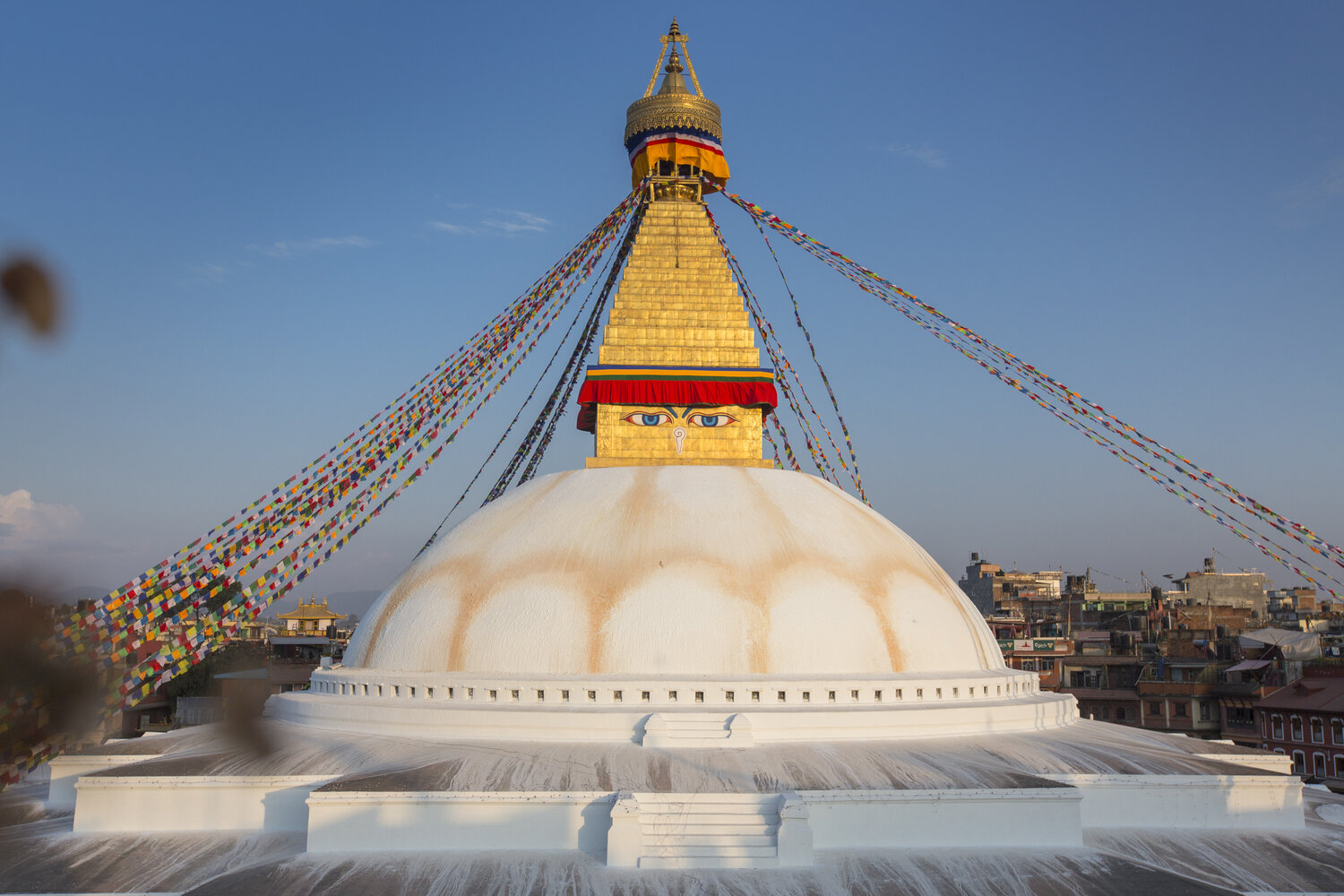
Just as they had prayed, the four brothers were later reborn in the snowy land of Tibet. There, they not only established Buddhism, but also greatly spread and strengthened the Buddhadharma throughout the land — founding monasteries, establishing the monastic sangha, and translating Buddhist scriptures.
Through their enlightened activities, Tibet eventually became renowned throughout the world as a sacred land of Vajrayana Buddhism.
For this reason, the stupa later became known as the “Wish-Fulfilling Stupa.”
It is said that if one makes an aspiration immediately upon first beholding the stupa, whatever one sincerely prays for may be accomplished. Because of its extraordinary blessings and miraculous power, it is regarded as one of the most sacred and wondrous sites in Tibetan Buddhism.
Today, this great stupa is located in Kathmandu, Nepal, and is widely known as the Boudhanath Stupa, or simply “Boudha.”
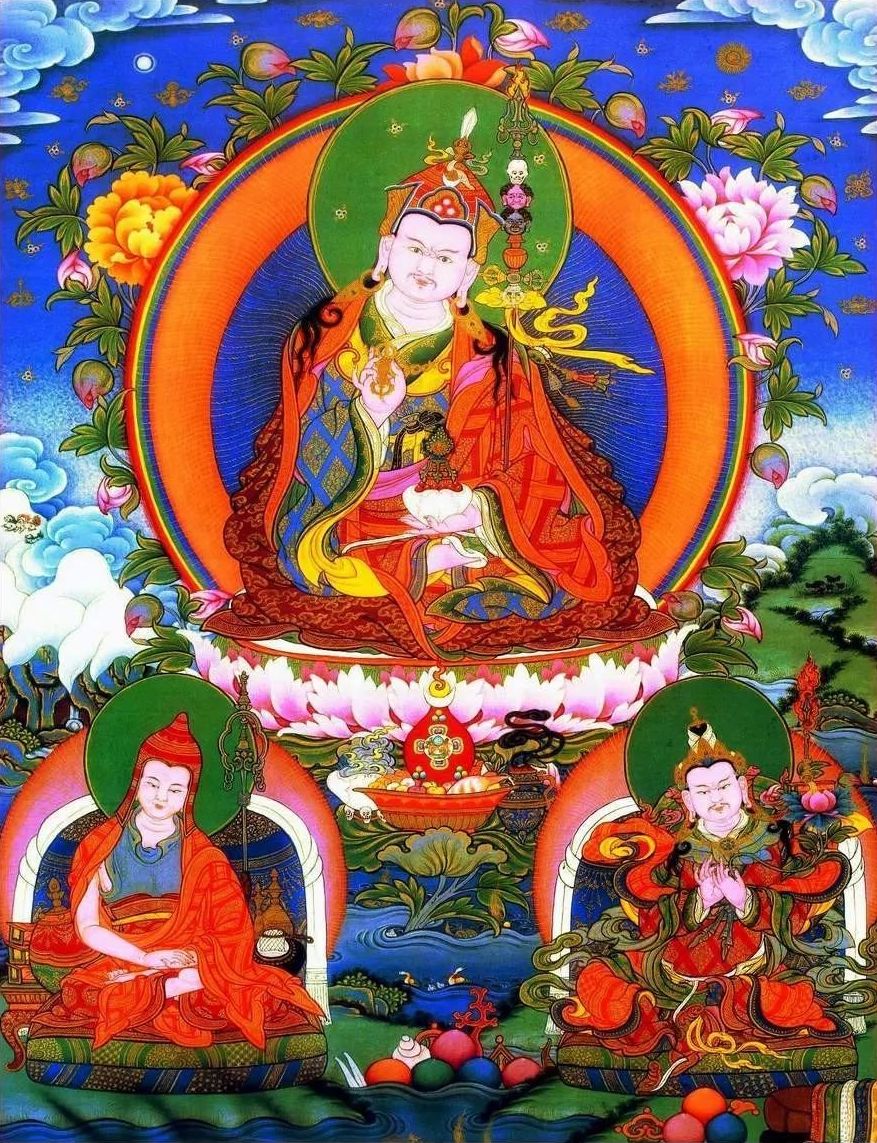
Among the four brothers who made those aspirations long ago, the first three were later reborn as:
-
King Trisong Detsen,
-
the great abbot Shantarakshita,
-
and the acharya Padmasambhava.
Together, they became renowned in history as the “Three Great Ones — Guru, King, and Abbot.” The fourth brother was reborn as a great minister who upheld and protected the kingdom.
At that time, King Trisong Deutsen had a beloved daughter named Princess Pema Sel. Through his enlightened vision, Guru Rinpoche foresaw that the princess would not live long. In order that she might swiftly attain accomplishment, he entrusted her upbringing personally to Yeshe Tsogyal and transmitted to her the most profound and essential Dharma teachings without reservation.
Because she was the king’s only daughter, she was deeply cherished by him. Tragically, however, the princess passed away at the age of twelve.
Overwhelmed with unbearable grief, King Trisong Deutsen immediately carried the body of his daughter upon horseback and rode through the night without rest to Samye Monastery — the miraculous spontaneously accomplished monastery — weeping as he begged Guru Rinpoche:
“Great Acharya! Is karma truly real?
If I am truly a king who upholds the sacred Dharma, then my daughter’s karma should have been pure.
But if her karma was pure, why did she die so young?
And if her karma was impure, how could she have been born as my daughter?”
Guru Rinpoche replied:
“Great King, do not despair.
This princess’s karma was not yet fully purified. She was in fact the rebirth of one toward whom you once created karmic debt. Long ago, when we four brothers were building the sacred stupa in Nepal, you unknowingly killed a small insect that had bitten you. That insect was the previous life of this princess. Because of that karmic connection, although she was reborn as your daughter, she was destined to die young.”
Upon hearing these words, the king’s sorrow became even deeper, and for a long time he could not recover from his grief.
Unable to bear the king’s continued pleading, Guru Rinpoche finally summoned back the consciousness of the princess and caused it to re-enter her body. He blew gently into her ear, and the princess returned briefly to life. Guru Rinpoche then bestowed empowerments and profound teachings upon her.
Not long afterward, however, the princess again passed away.
At that time, Guru Padmasambhava, King Trisong Deutsen, Yeshe Tsogyal, the twenty-five disciples of the king and ministers, together with vast assemblies of dakinis and heroic beings filling the sky like clouds, all gathered together and made powerful aspirations for the princess.
They prayed that in her future lives she would continue diligently upon the path of practice, swiftly attain realization, and afterward spread the pure Buddhadharma widely throughout the world — especially by revealing the most profound and essential hidden treasure teachings for the benefit of sentient beings.
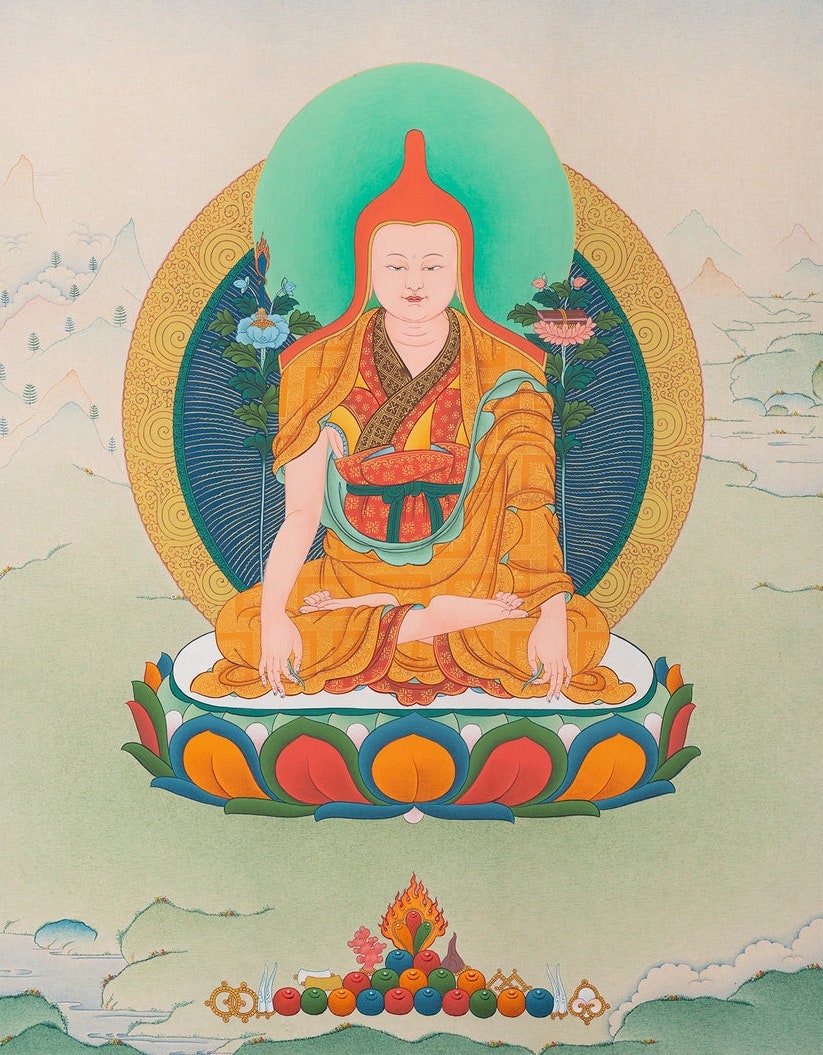
Through the inconceivable blessings of Guru Padmasambhava and the collective aspirations and prayers of the king, ministers, disciples, and realized beings, the princess passed through five impure rebirths and five pure rebirths.
After enduring countless hardships across many lifetimes and practicing with extraordinary perseverance, she eventually attained complete realization and became one of the great masters of Tibetan Buddhism.
Among her five pure rebirths, she successively manifested as:
-
The spiritual consort of the First Treasure King, Nyangrel Nyima Ozer
-
The spiritual consort of the Second Treasure King, Guru Chowang
-
Padma Ledrel Tsal, the first treasure revealer of the Khandro Nyingtik lineage
-
Longchenpa, revered as one of the Three Great Mañjuśrīs of Tibet
-
Pema Lingpa, the western Lotus-family Treasure King among the Five Great Treasure Kings
Thus, Treasure King Pema Lingpa became one of the most celebrated and revered masters in the history of Tibetan Buddhism.
Compared to many other realized beings, the life story of Pema Lingpa — marked by immense hardship, perseverance, and accomplishment across countless lifetimes — is especially moving, heroic, and deeply inspiring.
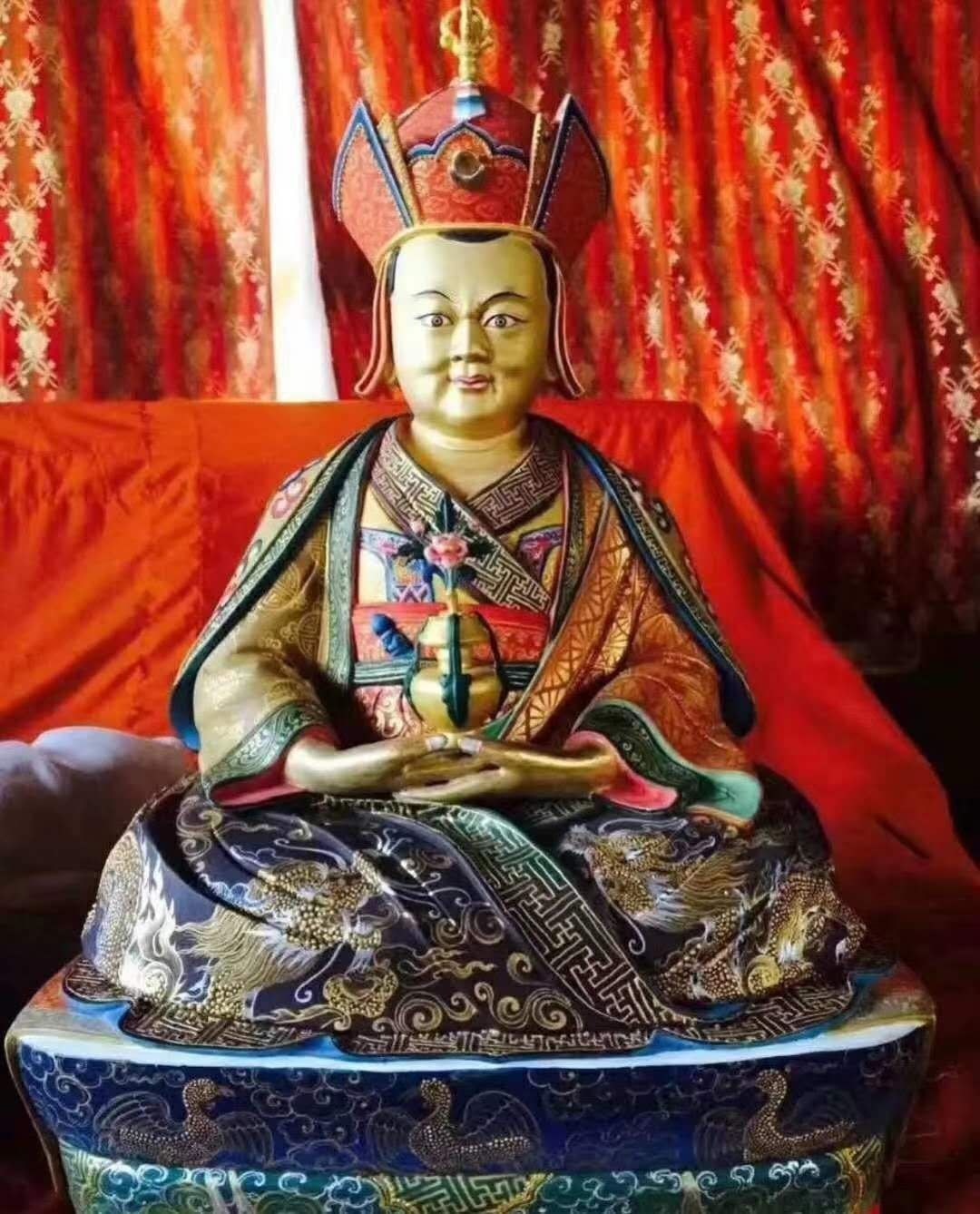 The Birth of the Treasure King Pema Lingpa
Pema Lingpa, the Treasure King Pema Lingpa, was born in Bhutan. Although he was regarded as the reincarnation of Longchenpa and extraordinary auspicious signs and omens appeared at the time of his birth, his mother passed away not long afterward.
As a result, the young Pema Lingpa was raised by his uncle. Living in poverty, he spent his childhood herding cattle and sheep, working as a blacksmith, carving wood and metal, and laboring to sustain his livelihood. Because of these difficult circumstances, he remained illiterate until the age of twenty-seven.
The Youth of the Treasure King Pema Lingpa
One day, when Pema Lingpa was twenty-seven years old, Guru Padmasambhava appeared before him in the form of a wandering yogi and awakened him from a midday nap.
The yogi said:
“Young man! I am hungry. Quickly prepare some food for me.”
Seeing that the visitor was a holy practitioner, Pema Lingpa dared not neglect him. After preparing food and returning to the yogi, the mysterious ascetic placed into his hands a catalogue of one hundred and eight treasures and asked:
“Do you still recognize me?
You must carefully follow my instructions and fully accomplish the task I entrust to you.”
Immediately after speaking these words, the yogi vanished without a trace.
From that moment onward, countless pure visions continuously arose for Pema Lingpa. He then began studying Tibetan writing under spiritual teachers, and due to the karmic tendencies carried from previous lives, he gradually became able to understand dakini script.
Whenever doubts or uncertainties arose, Yeshe Tsogyal herself would appear before him and personally guide him.
Later, when Pema Lingpa began revealing treasures but was unable to decipher certain dakini symbols and secret scripts, both Guru Rinpoche and Lady Yeshe Tsogyal would manifest directly to instruct him.
For this reason, the treasures revealed by Pema Lingpa were personally guided and confirmed by Guru Padmasambhava and Yeshe Tsogyal themselves. Thus, his terma teachings are regarded as complete original transmissions — utterly pure, reliable, and free from even the slightest addition, corruption, or omission.
Among the one hundred and eight treasures listed within the prophetic catalogue, because of the collective karma and circumstances of sentient beings, Pema Lingpa ultimately revealed only thirty-two precious treasure cycles.
Yet every one of these revealed termas was considered extraordinarily rare and unparalleled in profundity and blessing.
Among the most renowned were the three great Dzogchen cycles:
-
The Complete Gathering of Samantabhadra’s Intent
-
Longsal
-
The Child Tantra Cycle
As well as the Three Roots accomplishment cycle:
-
The Ocean of Guru Mind Accomplishment
And the Avalokiteshvara and Heruka treasure teachings:
-
The Red Avalokiteshvara — Lamp That Dispels All Darkness
-
The Extremely Secret Mirror of Enlightened Mind
-
and the accomplishment practices of the Eight Great Herukas.
These treasure revelations became some of the most important and influential teachings within the Nyingma tradition and the Pema Lingpa lineage.
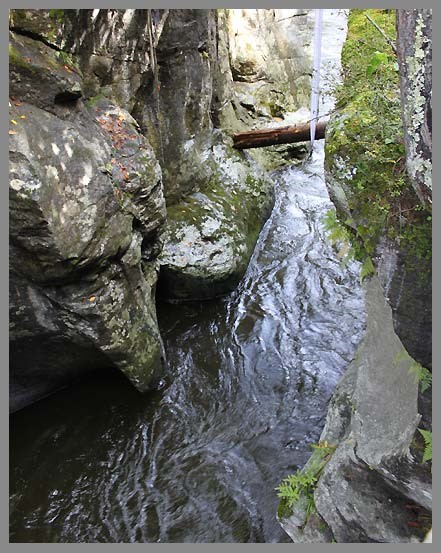
(Image on the left) In 1450, Pema Lingpa was born in the Bumthang region of present-day Bhutan. During his lifetime, he revealed treasure teachings from eighteen different treasure sites.
Among these, the most renowned is the sacred revelation at Mebar Tsho, the Burning Lake of Bumthang. This place lies within a deep mountain valley surrounded by lush forests, where rushing streams gather and flow into a profound sacred pool.
The Family Lineage of Pema Lingpa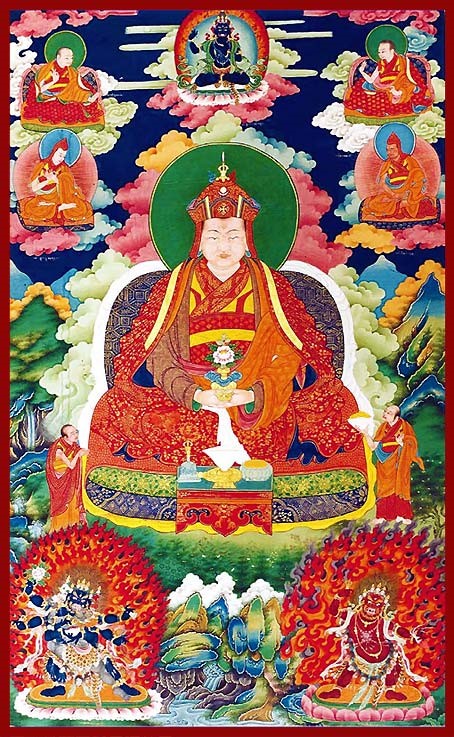
Within the family tradition and reincarnation lineage of the Treasure King Pema Lingpa, countless realized masters have appeared. The Sixth Dalai Lama and the present King of Bhutan are among the notable examples connected with this sacred lineage.
Pema Lingpa once prophesied:
“In the future, within the Lotus Realm, I shall attain buddhahood as Vajra Heart Buddha. Those who are connected with me now will be reborn in that realm and become disciples to be guided by me.”
After Pema Lingpa passed into parinirvana, he manifested in five principal emanations: body, speech, mind, activity, and qualities.
Among them, the First Body Emanation established a monastery in the Gangteng region of present-day Bhutan, thereby beginning the lineage of the Gangteng Tulkus, the body emanation lineage of Pema Lingpa. The present Gangteng Tulku is the Ninth Incarnation in this sacred lineage.
The reincarnations of Pema Lingpa’s emanations have continuously upheld and transmitted his teachings throughout Bhutan. Today, through the compassion and enlightened activities of Gangteng Tulku Rinpoche, the teachings of Pema Lingpa have spread beyond Bhutan to Europe, North America, and many other parts of the world.